Jitsug Etsu
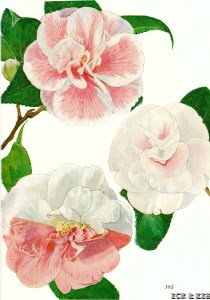
An 1898 Japanese sasanqua that bears red and white flowers on the same tree — with variegated leaves adding a second layer of bicolor interest.
First documented by Ashizawa in 1898, this Japanese sasanqua is distinctive for bearing both red and white flowers on the same tree — a chimeral characteristic where different shoots produce different-colored blooms. White blooms are rarely produced on young trees. The variegated dark green leaves add a second dimension of bicolor interest. Growth is slender and slow with small single flowers of four to five petals. The name 'Jitsugetsu' translates to 'sun and moon' — perhaps referencing the dual coloring. Listed locally as 'Jitsug Etsu' and registered as 'Jitsugetsu.' Source: International Camellia Register.