Tama Noveau
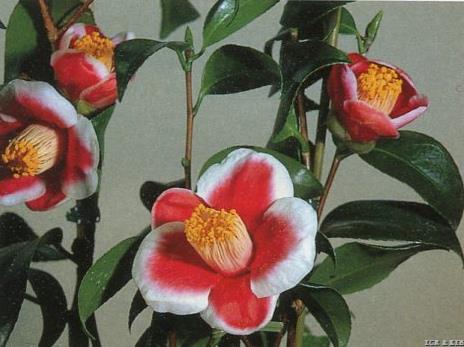
Discovered wild in 1947 on a remote island in the Gotō Archipelago — the original white-bordered red single that launched an entire breeding line.
The foundational cultivar behind an entire breeding line of white-bordered camellias. Discovered growing wild by Tomokazu Fujita in 1947 at the place called Tama-no-ura on Fuku'e Island in the Gotō Archipelago, Nagasaki Prefecture, Japan. The medium campanulate single with six petals displays red edged with clear white — a picotee pattern that tends to disappear on late blooms and young plants. Selected by Konomi Masahiro of Kurume City. Dark green long-lanceolate leaves with tapering acuminate apex and gently wavy serrate margins. Listed locally as 'Tama Noveau' and registered as 'Tama-no-ura.' Source: International Camellia Register.